
Sport in a new climate – rising temperatures, rising concerns
Climate ResilienceArticleApril 4, 2025
Extreme weather is having an increasing impact on sport
There is a crescendo of noise around extreme weather and it’s growing impact on sport. On one hand it is clear more sports are feeling the effects. On the other, more coverage of the topic means that more clubs, athletes, spectators and other important stakeholders are becoming aware of the risks and measures to reduce the impacts.
Leaders in the world of sport are concerned and looking for climate resilience solutions
TNT Sports premiered its ‘Playing For Our Future’ documentary in the UK last week. Leading figures from the world of sport and climate change experts shared insights on the climate risks facing sport. The results from a study carried out by Zurich Resilience Solutions (ZRS) were shared in the documentary. Our research highlights the risk to men’s professional football in England. The documentary can be viewed on Discovery+.
Green Football Weekend, the world’s largest football campaign tacking climate hazards, has been taking place over the last few weeks and shed more light on the impact of changing weather on football. One of the campaign’s stories was a series of images capturing the disproportionate risk grassroots football faces from extreme weather. ZRS has been involved in Green Football Weekend by contributing to a research piece looking into impacts and disruption to women’s football.
Climate hazards and insights
The ZRS Climate Resilience team hosted a webinar at the end of March - ‘Sport in a New Climate: Adapting to a Changing Game’ where we provided an overview of the current and future state of the climate both globally and in the UK, including the Environment Agency’s new flood data which shows that with climate change the number of properties in areas at risk of flooding could increase to around 8 million (from 6.3 million currently) by mid-century.
We also presented a number of case studies to demonstrate how clubs have been impacted, focusing on Worcestershire County Cricket Club on the banks of the River Severn and AFC Wimbledon which was severely damaged in September 2024 following heavy rainfall and resulted in 3 weeks of clean up and repair.
Is your sport or organisation doing enough about climate mitigation and contingency planning
A series of climate resilience and adaptation considerations were presented focusing on measures related to planning, preparation and physical changes, with steps taken by the Australian Open and Corbridge Cricket Club discussed to highlight real investments sports organisations are making.
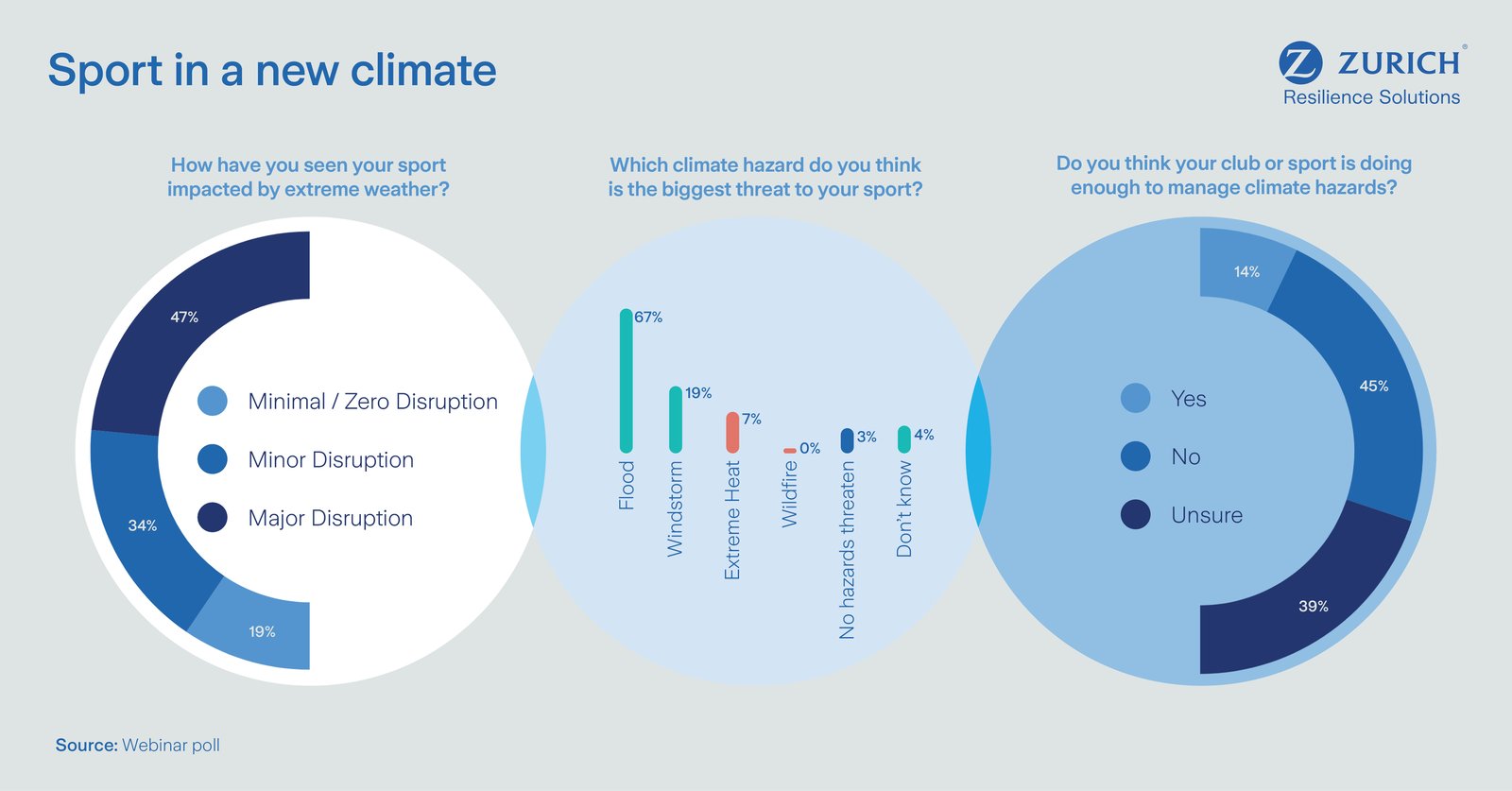
During the webinar we ran a poll to understand the view from our audience on climate risk. Figure 1, below, shows the 47% of attendees (from a total of 70 responses ) indicated that they had seen major disruption to their sport, this could for example include cancellations or significant postponements, physical damage to buildings or stadiums, or health and safety concerns for athletes or spectators. When considering minor disruption, the results show that 81% have seen disruption by extreme weather to their sport, either minor or major disruption.
Flood was selected by 67% of attendees (from a total of 70 responses) as the climate hazard that is the biggest threat to their sport, followed by windstorm (19%) and extreme heat (7%). This is no surprise, given that the majority of attendees were UK based, and flooding is the principal hazard of concern in the UK. If the webinar were to be run in the US, then we’d expect wildfire, and windstorms to be of greater concern. If the poll question was to be run in 10 years’ time, it’s likely that there would be a greater weighting towards extreme heat.
45% of attendees believe their club or sport is not doing enough to manage climate hazards. 14% think they are doing enough, and 39% are unsure. There has been significant stakeholder and consumer pressure for some time now for sport organisations to reduce their environmental impact and mitigate carbon, energy and water use.
Less focus has been placed on the need to build resilience to climate hazards, which has become particularly pertinent in recent years as global targets seem increasingly likely to be missed, and extreme weather impacts are worsening.
People are seeing this, and similar pressure is now being applied for sport organisations to adapt. Ultimately the level of physical climate risk is not proportionate to the level of resilience action being taken.
Extreme weather affects the performance levels of professional sports stars
Finally, during the webinar, David Wheeler, a professional footballer for Shrewsbury Town, and a sustainability ambassador for the Professional Footballers Association, Pledgeball, and Football for Future, shared his experiences of extreme weather.
David highlighted that the growing fluctuations in weather within the year is leading to increases in some types of injuries. In the summer months, pitches are hardening and drying out much faster which leads to ligament-related injuries and tendinopathies.
Whereas in the winter months, prolonged and severe rainfall is softening pitches which causes a greater chance of muscular injuries. David also mentioned that playing in extreme heat is simply not enjoyable and the quality of play dips as players aren’t able to produce the same level of performance as they are used to.
Climate hazards and resilience solutions
Every organisation and sector is affected by climate change but there is some optimism about the future, according to David:
Sustainability is becoming much more prevalent within clubs. Most clubs are starting to try to do the right thing behind the scenes. In terms of mitigation from actual natural disasters or flooding or damage from wind, I think it is very minimal and is usually quite reactive rather than proactive. I think a lot of clubs tend to be quite reliant on their local council stepping in and putting in defences.
The ZRS Climate Resilience team will continue to leverage its expertise in climate risk management to support the sport – and organisations in all sectors - to adapt. Action starts with knowledge. High quality data is the starting point to understanding the type and size of the climate hazards facing your organisation.
To learn more about our climate resilience solutions please contact us.